


The New Language of Wellbeing: Why Creativity and Mental Health Are Converging
a subtle but significant shift is becoming visible in how wellbeing and personal growth are being discussed. This is not a new trend nor another self-improvement technique entering the market. It is a quiet convergence between domains that were long treated as separate: mental health, creativity, and everyday quality of life.
Analyses published at the end of 2025 and into the opening weeks of the new year suggest that a broader understanding of wellbeing is emerging. Creative and artistic experiences are no longer framed as cultural extras or leisure activities, but as structural elements of psychological balance. A growing body of research and field observation indicates that practices such as music, writing, movement, and hands-on creative work can measurably influence emotional regulation, stress resilience, and a person’s sense of meaning.
What makes this development particularly relevant is its cultural context. After years of framing wellbeing as individual performance — optimizing the body, training the mind, maximizing productivity — a widespread fatigue with the idea of “functioning better” is becoming apparent. In its place, a different question is taking shape: how to live in a way that feels mentally and emotionally inhabitable.
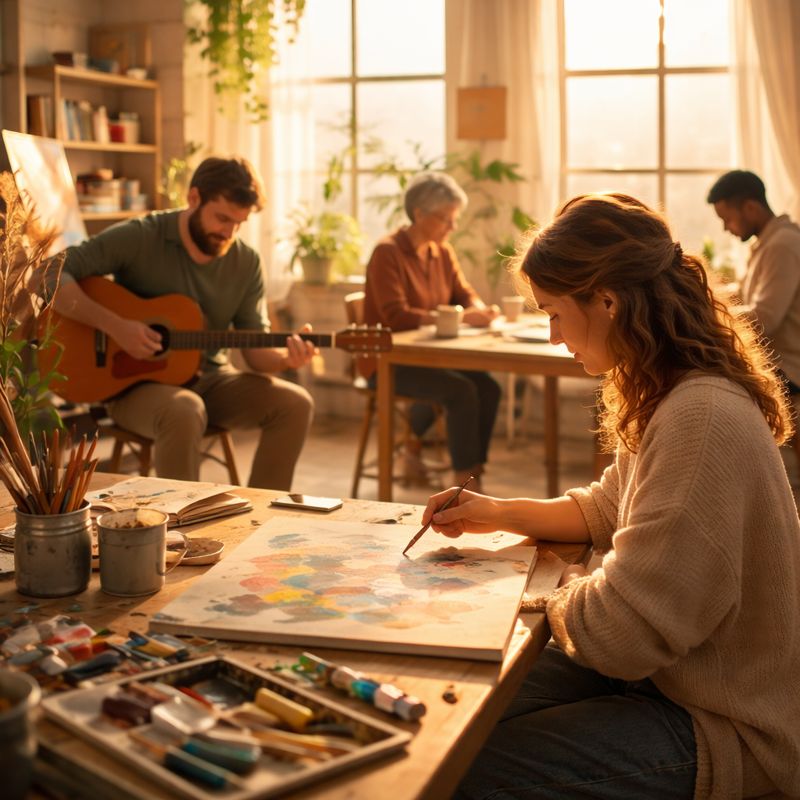
Within this shift, creativity is being redefined. It is no longer promoted primarily as self-expression or personal branding, but as a practical way to reorganize inner experience. Engaging in creative activity without goals, outcomes, or audiences allows the mind to step out of habitual control loops. It is precisely this suspension of purpose that appears to support nervous system regulation and reduce the chronic mental load reported by many people.
Notably this approach is gaining traction even outside explicitly spiritual or therapeutic contexts. Fields such as healthcare, education, and social services are beginning to treat creative engagement as a legitimate support for mental health rather than an optional add-on. This signals a deeper cultural transition: wellbeing is no longer defined solely by symptom reduction, but by the quality of lived experience.
From a personal growth perspective, this convergence challenges long-held assumptions. If mental health improves not only through cognitive correction or behavioral discipline, but through changes in how individuals relate to time, the body, and sensory experience, then the very idea of self-work shifts. Growth becomes less about accumulation and more about creating conditions in which presence can emerge.
This perspective remains provisional and unfinished. There are no universal formulas or definitive models. Yet the direction is clear. Personal growth is slowly moving away from control and toward integration. In this context, creativity is not an escape from reality, but a form of grounded realism — a way of reconnecting with what makes life mentally and emotionally sustainable.
Analyses published at the end of 2025 and into the opening weeks of the new year suggest that a broader understanding of wellbeing is emerging. Creative and artistic experiences are no longer framed as cultural extras or leisure activities, but as structural elements of psychological balance. A growing body of research and field observation indicates that practices such as music, writing, movement, and hands-on creative work can measurably influence emotional regulation, stress resilience, and a person’s sense of meaning.
What makes this development particularly relevant is its cultural context. After years of framing wellbeing as individual performance — optimizing the body, training the mind, maximizing productivity — a widespread fatigue with the idea of “functioning better” is becoming apparent. In its place, a different question is taking shape: how to live in a way that feels mentally and emotionally inhabitable.
Within this shift, creativity is being redefined. It is no longer promoted primarily as self-expression or personal branding, but as a practical way to reorganize inner experience. Engaging in creative activity without goals, outcomes, or audiences allows the mind to step out of habitual control loops. It is precisely this suspension of purpose that appears to support nervous system regulation and reduce the chronic mental load reported by many people.
Notably this approach is gaining traction even outside explicitly spiritual or therapeutic contexts. Fields such as healthcare, education, and social services are beginning to treat creative engagement as a legitimate support for mental health rather than an optional add-on. This signals a deeper cultural transition: wellbeing is no longer defined solely by symptom reduction, but by the quality of lived experience.
From a personal growth perspective, this convergence challenges long-held assumptions. If mental health improves not only through cognitive correction or behavioral discipline, but through changes in how individuals relate to time, the body, and sensory experience, then the very idea of self-work shifts. Growth becomes less about accumulation and more about creating conditions in which presence can emerge.
This perspective remains provisional and unfinished. There are no universal formulas or definitive models. Yet the direction is clear. Personal growth is slowly moving away from control and toward integration. In this context, creativity is not an escape from reality, but a form of grounded realism — a way of reconnecting with what makes life mentally and emotionally sustainable.