


The Great Nutrient Collapse: How Healthy Soil Is the Secret to a Nourished Soul and a Resilient Planet
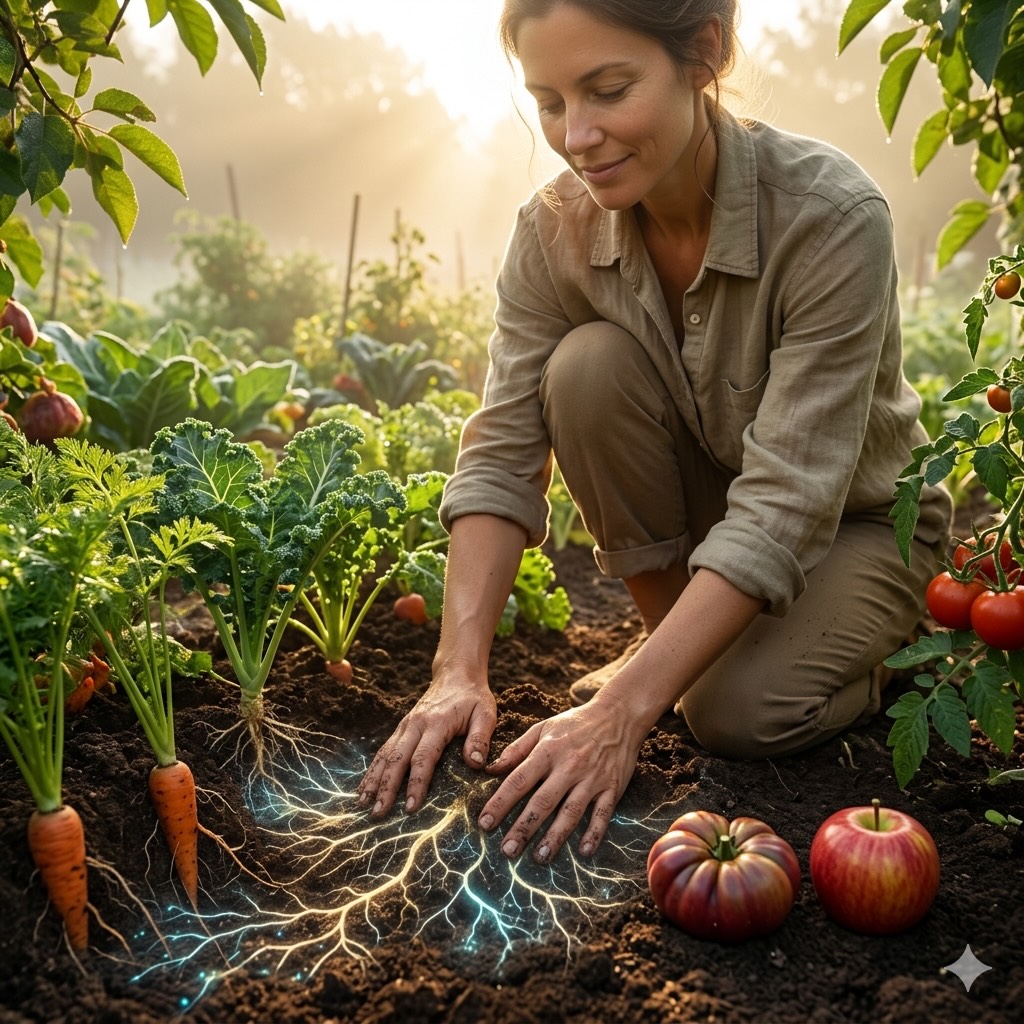
In an age of digital immortality, where technology seems to promise an endless future, an ancient truth is forcefully re-entering the scientific and philosophical debate: our health does not begin at the table, but dozens of centimeters beneath our feet. The carrot we casually munch during a work break, or the salad we consider the cornerstone of our well-being, hide a disturbing secret that modern science calls "hidden hunger." Despite the abundance of calories, essential nutrients are vanishing. A groundbreaking report by the Rodale Institute, supported by decades of comparative studies and analyses published in esteemed journals like The Lancet Planetary Health, reveals that the link between soil vitality and our psychophysical resilience is much deeper and more visceral than we ever dared to imagine.
The 21st-century paradox is served: we are the most fed generation in history, but biochemically among the most malnourished. Research led by Dr. Donald Davis from the University of Texas analyzed nutritional data from the U.S. Department of Agriculture on 43 different garden crops, comparing values from 1950 to 1999. The results are a bucket of cold water for any wellness enthusiast: significant declines in calcium, phosphorus, iron, riboflavin, and vitamin C. Put simply, to obtain the same amount of nutrients our grandparents derived from a single apple, we would have to eat five or six today. This phenomenon is not biological inevitability, but the direct consequence of intensive agriculture that treated the land as mere inert support for chemical fertilizers (N-P-K: nitrogen, phosphorus, and potassium), neglecting the complex network of underground life.
To understand this crisis, we must view the soil not as "dirt," but as a living, pulsating organism. Beneath our every step lives the "soil food web," a universe composed of bacteria, protozoa, and, most importantly, mycorrhizal fungi. These act as a sort of biological internet, connecting plant roots to each other and allowing the exchange of rare minerals for sugars produced by photosynthesis. When we use pesticides and deep plowing, we destroy this delicate balance. The plant, though it grows vigorously in appearance thanks to fertilizers, remains an "orphan" of the micronutrients and phytochemical compounds that only symbiosis with living soil can guarantee. Those compounds, like polyphenols and antioxidants, are exactly what our immune system requires to combat chronic inflammation and oxidative stress.
Here, science meets what could be called a secular spirituality of matter. Recognizing that our cells are literally composed of minerals extracted from the soil transforms the act of eating into a rite of communion with the planet. It is not about religion, but profound ecological awareness: we are an extension of the ground we walk upon. If the soil is sick, exhausted, and lifeless, our bodies will inevitably reflect that energetic poverty. The feeling of chronic fatigue, brain fog, and emotional vulnerability that plagues modern society may have roots less psychological and more terrestrial than we think. We are mineral beings who have forgotten our foundations.
The good news comes from Regenerative Nutrition, a global movement gaining traction that proposes a holistic view of health. The goal is no longer just producing "organic" food (i.e., pesticide-free), but "regenerative" food, capable of restoring the earth's fertility while nourishing humanity. Regenerative farmers use techniques like cover cropping and rotational grazing to sequester carbon from the atmosphere back into the soil, creating a virtuous cycle. Carbon-rich soil is spongy soil, capable of holding water and nourishing incredibly nutrient-dense plants. Choosing these foods thus becomes a political and spiritual act: it means voting for life, for your own and the planet’s, with every single bite.
For the reader of Spiritual.it, this paradigm shift offers a new compass for personal growth. Self-care can no longer end at the skin's edge. True evolution lies in recovering the "nutrient density" of our existence. This means learning to distinguish volume from value, satiety from nourishment. Beginning to seek small producers who practice conservation agriculture, rediscovering ancient grain and legume varieties (often richer in minerals than modern varieties selected for industrial yield), and above all, refinding a sense of gratitude for what the soil offers us.
In conclusion, the health of the future will not be built in pharmaceutical laboratories but in the regeneration of humus. When we eat food grown in healthy soil, we are ingesting information of harmony and complexity. We are nourishing not only our muscles but our capacity to remain clear-headed, empathetic, and connected to the rhythm of life. The secular spirituality of the plate teaches us that a healthy "I" cannot exist in a sick "world." We are part of a single planetary metabolism, and rediscovering the sacredness of the earth beneath our fingernails is, perhaps, the first real step toward a healing that is, at the same time, biological and internal. Nourishing the soil is, in all respects, the most direct and powerful way to nourish our soul.
The 21st-century paradox is served: we are the most fed generation in history, but biochemically among the most malnourished. Research led by Dr. Donald Davis from the University of Texas analyzed nutritional data from the U.S. Department of Agriculture on 43 different garden crops, comparing values from 1950 to 1999. The results are a bucket of cold water for any wellness enthusiast: significant declines in calcium, phosphorus, iron, riboflavin, and vitamin C. Put simply, to obtain the same amount of nutrients our grandparents derived from a single apple, we would have to eat five or six today. This phenomenon is not biological inevitability, but the direct consequence of intensive agriculture that treated the land as mere inert support for chemical fertilizers (N-P-K: nitrogen, phosphorus, and potassium), neglecting the complex network of underground life.
To understand this crisis, we must view the soil not as "dirt," but as a living, pulsating organism. Beneath our every step lives the "soil food web," a universe composed of bacteria, protozoa, and, most importantly, mycorrhizal fungi. These act as a sort of biological internet, connecting plant roots to each other and allowing the exchange of rare minerals for sugars produced by photosynthesis. When we use pesticides and deep plowing, we destroy this delicate balance. The plant, though it grows vigorously in appearance thanks to fertilizers, remains an "orphan" of the micronutrients and phytochemical compounds that only symbiosis with living soil can guarantee. Those compounds, like polyphenols and antioxidants, are exactly what our immune system requires to combat chronic inflammation and oxidative stress.
Here, science meets what could be called a secular spirituality of matter. Recognizing that our cells are literally composed of minerals extracted from the soil transforms the act of eating into a rite of communion with the planet. It is not about religion, but profound ecological awareness: we are an extension of the ground we walk upon. If the soil is sick, exhausted, and lifeless, our bodies will inevitably reflect that energetic poverty. The feeling of chronic fatigue, brain fog, and emotional vulnerability that plagues modern society may have roots less psychological and more terrestrial than we think. We are mineral beings who have forgotten our foundations.
The good news comes from Regenerative Nutrition, a global movement gaining traction that proposes a holistic view of health. The goal is no longer just producing "organic" food (i.e., pesticide-free), but "regenerative" food, capable of restoring the earth's fertility while nourishing humanity. Regenerative farmers use techniques like cover cropping and rotational grazing to sequester carbon from the atmosphere back into the soil, creating a virtuous cycle. Carbon-rich soil is spongy soil, capable of holding water and nourishing incredibly nutrient-dense plants. Choosing these foods thus becomes a political and spiritual act: it means voting for life, for your own and the planet’s, with every single bite.
For the reader of Spiritual.it, this paradigm shift offers a new compass for personal growth. Self-care can no longer end at the skin's edge. True evolution lies in recovering the "nutrient density" of our existence. This means learning to distinguish volume from value, satiety from nourishment. Beginning to seek small producers who practice conservation agriculture, rediscovering ancient grain and legume varieties (often richer in minerals than modern varieties selected for industrial yield), and above all, refinding a sense of gratitude for what the soil offers us.
In conclusion, the health of the future will not be built in pharmaceutical laboratories but in the regeneration of humus. When we eat food grown in healthy soil, we are ingesting information of harmony and complexity. We are nourishing not only our muscles but our capacity to remain clear-headed, empathetic, and connected to the rhythm of life. The secular spirituality of the plate teaches us that a healthy "I" cannot exist in a sick "world." We are part of a single planetary metabolism, and rediscovering the sacredness of the earth beneath our fingernails is, perhaps, the first real step toward a healing that is, at the same time, biological and internal. Nourishing the soil is, in all respects, the most direct and powerful way to nourish our soul.