


Tai Chi: The Moving Meditation That Protects the Brain and Regenerates the Body
Three hundred million practitioners across more than one hundred and fifty countries. This is not the reach of an Olympic sport or a global gym chain: it is the current worldwide diffusion of Tai Chi Chuan, the ancient Chinese martial art that over recent decades has crossed oceans and cultures to become one of the most scientifically studied tools of integrated wellbeing in the world. And the results of that research are redrawing the way we think about movement, aging and the health of the mind.
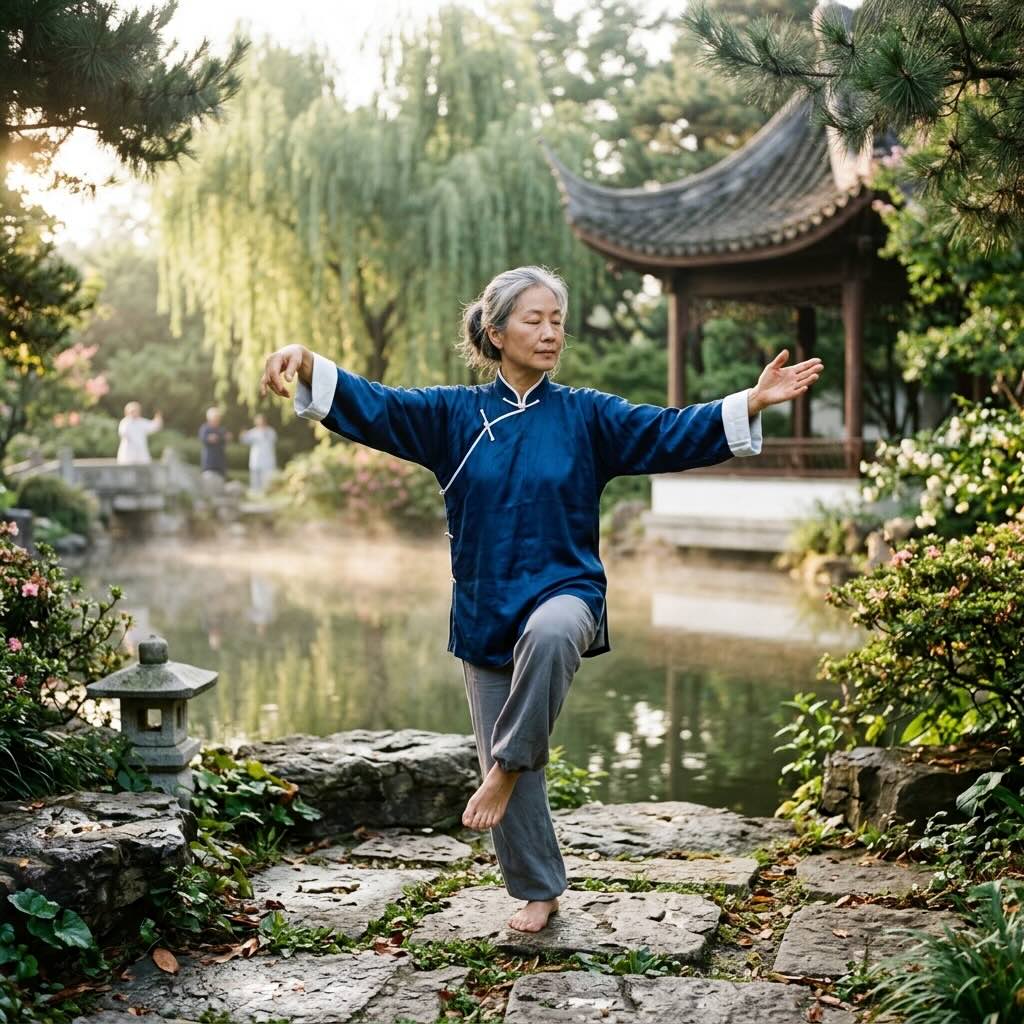
Tai Chi resembles no other form of physical exercise. Its movements — slow, fluid, linked in precise sequences — seek neither speed nor muscular power. They seek balance, presence, coordination between body, breath and attention. It is no coincidence that the scientific literature frequently defines it as "meditation in motion": a practice that integrates, in every single gesture, the physical, mental and spiritual dimensions that Western disciplines tend to keep separate.
A systematic review and meta-analysis published in 2025 in Frontiers in Physiology synthesized the available evidence on the effects of Tai Chi Chuan on cognitive function in adults aged sixty and over with mild cognitive impairment — a condition that represents one of the major risk factors for the development of dementia. The findings are clear: regular Tai Chi practice produces significant improvements in global cognitive function, with particularly pronounced effects on memory and executive function — that capacity to plan, organize and carry through complex actions which is among the first to deteriorate in pathological aging.
The mechanisms through which Tai Chi acts on the brain are multiple and synergistic. At the cardiovascular level, it is a moderate-intensity aerobic exercise — comparable to brisk walking — that increases cerebral blood flow and stimulates the production of BDNF, the neurotrophic factor that promotes the growth and survival of neurons. At the cognitive level, learning and executing the movement sequences — which require sustained attention, procedural memory and precise coordination — constitute a form of continuous mental training that is embedded within the physical activity itself. At the neuropsychological level, the meditative dimension of Tai Chi reduces anxiety, stress and depressive symptoms, all of which are independent risk factors for cognitive decline.
A study published in Scientific Reports in 2025 added a particularly illuminating piece to this picture: nine weeks of Tai Chi Chuan practice produce measurable changes in cerebral functional connectivity — that is, in the way different areas of the brain communicate with each other at rest. Participants showed greater integration between frontal and posterior regions, associated with improvements in dynamic balance performance and executive function. These were not subjectively perceived effects: they were differences visible in neuroimaging scans.
The impact of Tai Chi does not stop at the brain. Its effects on balance and fall prevention in older adults are among the most extensively documented in the entire literature on integrative medicine: those who practice Tai Chi regularly fall less, recover more quickly after a loss of balance, and maintain superior functional mobility compared to sedentary peers. At a time when falls among the elderly represent one of the leading causes of hospitalization and loss of independence, this finding carries public health implications that are difficult to overstate.
But what makes Tai Chi particularly compelling for readers with a holistic sensibility is its intrinsically integrated nature. It is not an exercise one does and then forgets: it is a practice that teaches a quality of presence — attention to breath, care for gesture, awareness of the body in space — that can transfer into daily life. Experienced practitioners describe a shift in the way they relate to stress, to time, to their own body: no longer an object to be pushed or corrected, but a space to inhabit with intention and respect.
Research conducted on more than three hundred older adults with mild cognitive impairment at the Oregon Research Institute compared a traditional Tai Chi program with a cognitively enhanced version — in which instructors were asked to further stimulate participants with mental tasks during the execution of movements — and with a control group that practiced stretching only. After six months, the cognitively enhanced Tai Chi group showed the most significant improvements in cognitive function, followed by the traditional Tai Chi group. The control group showed no meaningful improvements.
The lesson emerging from this research is clear, and it challenges one of the most deeply ingrained assumptions of contemporary wellness culture: it is not necessary to sweat, to suffer, or to accelerate in order to improve brain health. Sometimes, slowing down — truly, intentionally, with art and discipline — is the most powerful form of care that exists.
Tai Chi resembles no other form of physical exercise. Its movements — slow, fluid, linked in precise sequences — seek neither speed nor muscular power. They seek balance, presence, coordination between body, breath and attention. It is no coincidence that the scientific literature frequently defines it as "meditation in motion": a practice that integrates, in every single gesture, the physical, mental and spiritual dimensions that Western disciplines tend to keep separate.
A systematic review and meta-analysis published in 2025 in Frontiers in Physiology synthesized the available evidence on the effects of Tai Chi Chuan on cognitive function in adults aged sixty and over with mild cognitive impairment — a condition that represents one of the major risk factors for the development of dementia. The findings are clear: regular Tai Chi practice produces significant improvements in global cognitive function, with particularly pronounced effects on memory and executive function — that capacity to plan, organize and carry through complex actions which is among the first to deteriorate in pathological aging.
The mechanisms through which Tai Chi acts on the brain are multiple and synergistic. At the cardiovascular level, it is a moderate-intensity aerobic exercise — comparable to brisk walking — that increases cerebral blood flow and stimulates the production of BDNF, the neurotrophic factor that promotes the growth and survival of neurons. At the cognitive level, learning and executing the movement sequences — which require sustained attention, procedural memory and precise coordination — constitute a form of continuous mental training that is embedded within the physical activity itself. At the neuropsychological level, the meditative dimension of Tai Chi reduces anxiety, stress and depressive symptoms, all of which are independent risk factors for cognitive decline.
A study published in Scientific Reports in 2025 added a particularly illuminating piece to this picture: nine weeks of Tai Chi Chuan practice produce measurable changes in cerebral functional connectivity — that is, in the way different areas of the brain communicate with each other at rest. Participants showed greater integration between frontal and posterior regions, associated with improvements in dynamic balance performance and executive function. These were not subjectively perceived effects: they were differences visible in neuroimaging scans.
The impact of Tai Chi does not stop at the brain. Its effects on balance and fall prevention in older adults are among the most extensively documented in the entire literature on integrative medicine: those who practice Tai Chi regularly fall less, recover more quickly after a loss of balance, and maintain superior functional mobility compared to sedentary peers. At a time when falls among the elderly represent one of the leading causes of hospitalization and loss of independence, this finding carries public health implications that are difficult to overstate.
But what makes Tai Chi particularly compelling for readers with a holistic sensibility is its intrinsically integrated nature. It is not an exercise one does and then forgets: it is a practice that teaches a quality of presence — attention to breath, care for gesture, awareness of the body in space — that can transfer into daily life. Experienced practitioners describe a shift in the way they relate to stress, to time, to their own body: no longer an object to be pushed or corrected, but a space to inhabit with intention and respect.
Research conducted on more than three hundred older adults with mild cognitive impairment at the Oregon Research Institute compared a traditional Tai Chi program with a cognitively enhanced version — in which instructors were asked to further stimulate participants with mental tasks during the execution of movements — and with a control group that practiced stretching only. After six months, the cognitively enhanced Tai Chi group showed the most significant improvements in cognitive function, followed by the traditional Tai Chi group. The control group showed no meaningful improvements.
The lesson emerging from this research is clear, and it challenges one of the most deeply ingrained assumptions of contemporary wellness culture: it is not necessary to sweat, to suffer, or to accelerate in order to improve brain health. Sometimes, slowing down — truly, intentionally, with art and discipline — is the most powerful form of care that exists.